In this guide
- What Is Paint Correction, Really?
- The Paint Correction Process, Step by Step
- How to Fix Paint Chips on a Car
- How to Remove Paint Transfer From a Car
- How to Fix Peeling Clear Coat
- How to Fix Peeling Paint on a Car
- Myth-Busting: Brake Fluid and Pressure Washers
- Kuwait's Climate and Your Paint: Practical Advice
- Prevention: The Cheapest Restoration Is the One You Avoid
- When to Call a Professional
Every car in Kuwait fights the same slow battle. Intense sun, fine desert dust, gritty car washes, the occasional shopping-trolley graze, and a stone thrown up from the road all leave their mark on the one part of the car everyone sees first: the paint. Over time the finish that once looked wet and deep starts to look flat, hazy, and tired. The good news is that most of that damage lives in the top layers of the paint. Which means a great deal of it can be corrected and restored rather than repainted.
This guide walks through the full picture of paint correction and restoration. What the process actually is. How to deal with the specific problems people search for most: chips down to the metal, foreign paint smeared across a panel after a bump, peeling clear coat, and paint that is flaking off in sheets. Along the way it clears up some persistent myths (no, you should not reach for the brake fluid) and explains where the sensible line sits between a weekend fix and a job for a professional.
What Is Paint Correction, Really?
Paint correction removes scratches, etchings, water spots, oxidation, swirl marks, and other surface flaws from a car's paint. Unlike basic polishing or waxing, it uses specific techniques and abrasive products to bring back the original depth and clarity of the paint, with the goal of restoring the finish so it looks as good as when it was first applied.
Put more plainly, correction is the art of restoring a car's appearance by working the paint itself rather than covering it up. It removes swirl marks, scratches, and other imperfections from the exterior surface and brings back the luster of the car without the cost of repainting at a body shop. That distinction matters. Repainting replaces the paint; correction refines the paint you already have.
A modern car's paint is built in layers: primer on the metal, the coloured base coat, and a transparent clear coat on top. The clear coat is the sacrificial shield. It is a very important layer that gives the car its sheen, protects the colour from the sun's UV rays so it retains its colour despite frequent sun exposure, and shields the paint from minor scratches. Almost all correction work happens inside this clear coat. The abrasives level the top few microns so that light passes through cleanly again instead of scattering off thousands of tiny scratches.
Key terms
- Clear coat
- The transparent top layer that gives the car its sheen, protects the colour from UV rays, and shields the paint from minor scratches. Almost all correction work happens inside this layer.
- Oxidation
- The dulling, chalky, faded look that develops as the clear coat degrades over time — accelerated by the strong sun, wind, and dust common in Kuwait's climate.
- Compounding
- The technique of removing a thin layer of the car's clear finish with abrasives to eliminate swirl marks and scratches. More aggressive than polishing; used for deeper defects.
- Polishing
- A finer abrasive step that follows compounding, removing haze and restoring the paint's depth and gloss. May take several passes depending on the finish required.
Frequently asked questions
Is Paint Correction Just Buffing?
Not quite. "Buffing" is a loose word people use for any machine polishing, but correction is usually a sequence of steps that use progressively finer abrasives. The.
For the most stubborn, deep defects such as heavy scratches and oxidation,— an effective but risky technique that can damage the paint if done incorrectly. So buffing is one part of the picture. True correction reads the damage first and then chooses the least aggressive combination of steps that will actually fix it.
What Does Paint Correction Remove — and What Is Oxidation?
Correction targets the flaws that sit within the clear coat. It.
Oxidation is worth understanding because it shows up constantly on cars that live under a strong sun. It is the dulling, chalky, faded look that develops as the clear coat degrades over time. One of the causes named by detailers is exactly what Kuwait's climate delivers in abundance: paint that becomes. Light to moderate oxidation lives in the clear coat, which is why polishing can often revive it. Once oxidation has eaten all the way through the clear coat into the colour, correction alone can no longer bring it back.
Will Paint Correction Remove Scratches?
Some of them. A scratch can be removed by correction only if it sits inside the clear coat.. Simple home test: drag a fingernail lightly across the scratch. If your nail catches, the scratch is probably too deep for polishing alone and will need paint, not just correction.
Does Buffing or Paint Correction Remove the Clear Coat?
Correction does remove clear coat — but only a very thin, controlled amount. Compounding is. Done properly, that is the whole point; you are shaving off a few microns to level the surface.
The danger is doing too much. Clear coat is finite, and aggressive or careless buffing can cut straight through it. Professionals guard against this by starting with the mildest product that works and only stepping up when needed:. The lesson for anyone doing this at home is to be conservative. It is always safer to take a little longer with a gentle product than to reach for the most aggressive compound and burn through the clear coat, which cannot be undone without repainting.
The Paint Correction Process, Step by Step
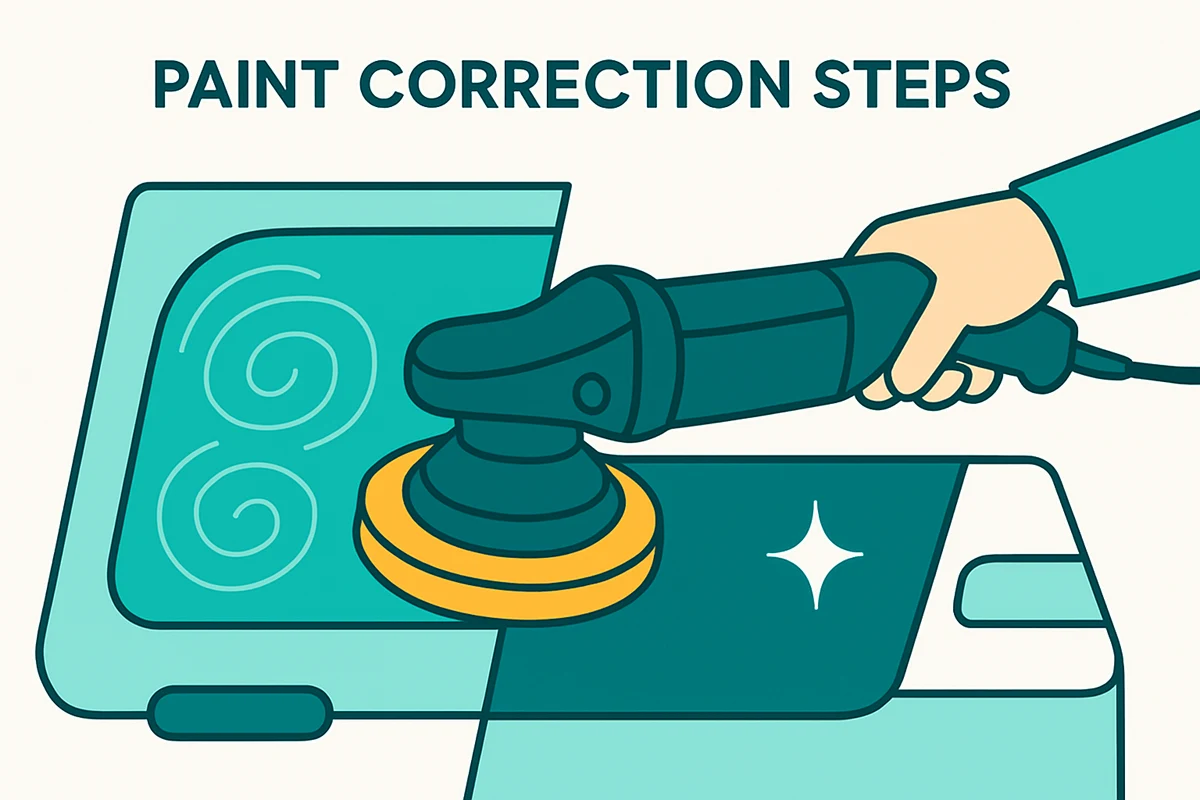
A proper correction is methodical. Skip the preparation and you polish dirt into the paint, creating new scratches. The typical sequence looks like this.
-
1
A thorough wash
The car must be. The surface should be as clean as possible before anything abrasive touches it.
-
2
Decontamination and claying
A standard wash cannot lift everything. After washing,. If you run your hand over the paint after claying it should feel like glass.
-
3
Compounding
This is where the actual correction starts. Compounding.
-
4
Polishing
Compounding can leave the paint looking slightly hazy or dull. Polishing.
-
5
Protection
Correction strips the paint back to bare, unprotected clear coat, so the last step is to seal it. It isand to.
The exact products and number of steps change with the condition of the paint.. There is no single fixed recipe; a good correction is tailored to the car in front of you.
How Long Does Paint Correction Last?
The correction itself is permanent in the sense that the flaws are physically removed — they do not grow back. What varies is how long the fresh, clear finish stays looking that way, and that comes down to protection and care afterward. On average,. In a harsh climate, that protection layer is doing a lot of work, which is why skipping it is a false economy.
Can I Do My Own Paint Correction?
You can, with realistic expectations.. A sensible middle path is to handle light maintenance polishing yourself and leave heavy, deep correction — the kind that flirts with the limits of the clear coat — to someone who does it every day.
How to Fix Paint Chips on a Car
Stone chips are the most-searched paint problem for a reason: they are almost unavoidable, and left alone they invite rust. A chip repair is fiddly but very doable at home if you respect the details. The single biggest factor in the result is not the technique so much as the paint.
Paint Selection and Colour Matching
Factory paint is tougher than the little bottle you buy. The paint on your car is a catalyzed paint, meaning it is mixed with a hardener to increase its strength, while pre-mixed touch-up paint is not catalyzed and will be softer than the paint on your car, so the repair ages differently and heats up faster than the surrounding paint when polished. That is not a reason to avoid touch-up paint; it is a reason to work gently around the repair afterward.
Colour matching is the part people underestimate. The popular idea that a paint shop's colour computer gives you a perfect match is misleading:. Metallic colours are the worst offenders, being.
One more quirk to plan for:. If you can, let a good paint mixer take their time to blend it over a couple of days rather than expecting an instant match.
Preparing and Filling the Chip
Clean first. After washing and drying,. Then look closely at how deep the chip goes..
Here two respected sources actually disagree, and the disagreement is instructive. MotorTrend's classic-car approach smooths the chip's edges before painting, noting that. A chip-repair specialist takes the opposite view for everyday cars and warns: do not sand down chips, because you need the edge of the chip to act like a bucket that holds the paint, and sanding the area smooth leaves nowhere for the touch-up paint to sit while also risking damage to the surrounding good paint. For a small everyday chip, filling it as-is and leaving the edge intact is the lower-risk approach. Any sanding should be minimal and cautious.
Avoid cotton buds, which shed fibers into the paint.
Clear coat touch-up in a bottle rarely works. One specialist is blunt that.
Levelling and Buffing the Repair
Once the chip is filled it sits proud of the surface and needs levelling, carefully. Use the finest sandpaper that will still work: MotorTrend advises.
Finish by blending:. Yes, you can compound a repair by hand. For touch-up paint it is often the safer choice.
The overarching rule from the professionals is simple., so take your time. And do not wait too long to start:.
How to Remove Paint Transfer From a Car
Paint transfer is that streak of someone else's colour left on your panel after a low-speed scrape in a car park. It looks alarming but it is often only sitting on top of your clear coat. Professional detailers approach it with one guiding principle: use the least abrasive method that works, because amateur removal attempts can make the problem much worse by scratching or stripping the clear coat. Work through these steps in order and stop as soon as the transfer is gone.
-
1
Wash first
Before anything else,. During the wash, lightly rubbing the transfer with a wash mitt may lift some of the foreign paint if it is fresh and sitting on the surface, but apply pressure cautiously and inspect often. Sometimes that is all it takes.
-
2
Try a clay towel
If washing alone does not do it,. Give it a fair go:.
-
3
Step up to a clay bar, carefully
If the towel fails,.
-
4
Polish the area afterward
Claying can leave fine marring, so.
-
5
Chemical solvents as a last resort
For the most stubborn transfer,.
What About WD-40, Rubbing Alcohol, and Toothpaste?
These three come up constantly in searches, and none of them appear in the professional removal process above. That itself is telling. The detailer's method deliberately climbs from gentlest to harshest. It reserves even proper automotive solvents for the very last resort with strict precautions. That is the sensible frame for any household product too.
Toothpaste is a mild abrasive, really just an unpredictable version of the polishing step. Rubbing alcohol is a solvent whose strength varies. Rather than gambling with random kitchen chemistry on your clear coat, the safer path is the graduated one: wash, clay, polish, and only then a tested, purpose-made solvent used sparingly. If in doubt, stop before the chemical stage and let a professional take it further.
How to Fix Peeling Clear Coat
Peeling clear coat is a different animal from a chip or a scratch. It is a failure of the top layer itself, usually from prolonged UV exposure, and it tends to spread. Address it promptly, because. A DIY repair is possible, and it runs broadly as follows.
Work in a clean, well-ventilated space and wear gloves, goggles, and a mask. You will need, among other things,. The process, in brief:.
Clean the sanded area,. After spraying,.
Two honest caveats come straight from the detailers who describe this method. First, on the popular search for fixing peeling clear coat "without repainting": the credible DIY route still involves respraying clear coat over the sanded area. There is no genuine shortcut that skips laying down new clear.
Second, and more important,. For a car that lives outdoors under a strong sun, a spot repair buys time. A lasting fix often means a professional respray of the panel.
How to Fix Peeling Paint on a Car
When the peeling goes deeper than the clear coat — when the colour itself is flaking away and you can see primer or metal — you have crossed from correction into refinishing. There is no polish or clay that rebuilds missing colour and clear coat. The realistic options are to strip the failed area back to a sound surface, re-prime if bare metal is exposed, and rebuild the base and clear coats. Or have the panel professionally refinished.
It is the same principle as the clear-coat repair above, scaled up: sand back to a stable edge, prime bare metal so the new paint has something to grip, and build the layers back in the correct order. Because colour-matched base coat over a large area is genuinely hard to blend invisibly, extensive peeling is usually the point at which professional refinishing earns its keep. Catching it early, while the affected area is still small, keeps you in DIY territory for longer and keeps the cost down.
Myth-Busting: Brake Fluid and Pressure Washers
A few "hacks" circulate online that are worth addressing head-on, because they can do real damage.
People ask whether brake fluid removes paint, and the honest answer is that this belongs nowhere near your paint-correction toolkit. Not one of the professional processes above — for correction, chips, transfer, peeling clear coat, or peeling paint — uses it. The detailers who do this for a living reserve even proper automotive solvents as a tested, closely-watched last resort precisely. Brake fluid is an aggressive, uncontrolled chemical with no place in that careful hierarchy. Keep it in the braking system where it belongs.
A well-maintained factory finish stands up to normal washing, and a pressure washer used at a sensible distance and pressure is a routine detailing tool. The realistic risk is not that a pressure washer blasts good paint off a sound panel. It is that high pressure aimed too close can lift paint that is already failing — around a chip, a rust spot, or an area where the clear coat is peeling.
In other words, a pressure washer tends to expose weak paint rather than create the weakness. The takeaway is to keep your distance from damaged areas and to fix chips and peeling early, before water pressure finds them.
Kuwait's Climate and Your Paint: Practical Advice
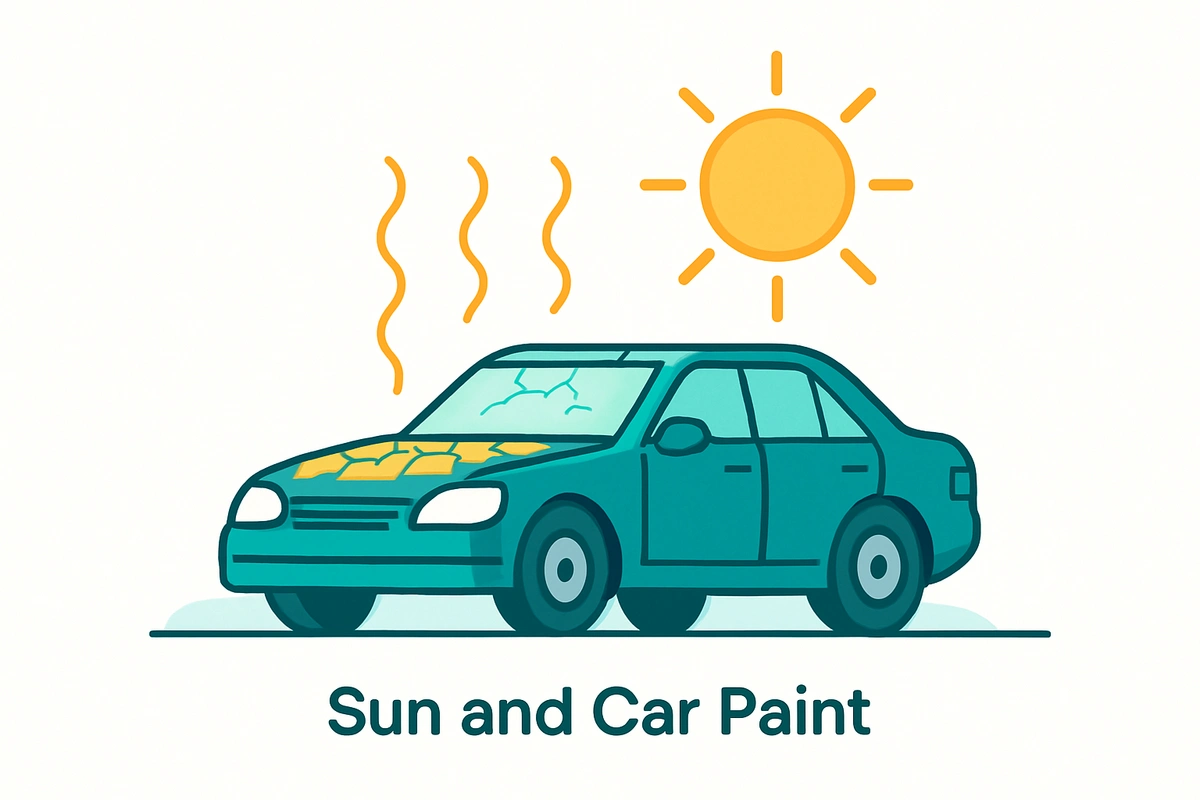
Nothing here is unique to Kuwait, but the local conditions turn up the intensity on every one of these problems, so a few adjustments are worth making.
The sun is the headline issue. UV is the main driver of both oxidation and clear coat failure, and the clear coat's job is precisely to. Under Kuwait's near-constant, high-intensity sunlight, that shield ages faster. Which is why oxidation and peeling clear coat show up sooner here than in milder climates.
The practical response is to lean hard on protection: after any correction, applying a sealant or ceramic coating tois not a luxury add-on. It is the part doing the heavy lifting. Parking in shade or under cover whenever possible extends the life of both the paint and any repair. And it is worth remembering that a DIY clear-coat spot repair explicitly— a real consideration when the car goes straight back out into the sun.
Dust and fine sand are the second factor, and they matter because so much paint damage is self-inflicted during washing. Grit dragged across a panel is exactly what creates the swirl marks that correction later has to remove —. In a dusty environment the two-bucket method and a clean wash mitt stop being niceties. They become the difference between preserving a finish and slowly sanding it dull.
It also raises the stakes on a habit one specialist calls out directly:. Add a film of abrasive dust to that and light contact scratches more readily still.
Heat compounds everything else. Bird droppings and tree sap are already urgent —— and a hot panel bakes them in faster. The same specialist's advice tois even more pressing in a hot climate. Heat also affects repairs: recall that touch-up paint, so a hand finish rather than an aggressive machine buff is the safer choice on a warm day.
Prevention: The Cheapest Restoration Is the One You Avoid
The theme running through every professional source here is that good maintenance prevents the expensive problems. The core habits are unglamorous and effective:, and. Use products made for cars, since.
There is a value argument here too, beyond appearance. A regularly detailed and protected car, and choosing correction and protection over a full repaint can be a. Looking after the paint you have is almost always cheaper than replacing it.
When to Call a Professional
DIY is genuinely appropriate for a lot of this: small stone chips, a fresh smear of paint transfer, light oxidation, minor swirl marks, and routine washing and waxing are all within reach of a careful owner with patience and the right products. The honest boundaries are these.
Deep correction that pushes the limits of the clear coat is risky, and. Wet sanding. Stubborn paint transfer that resists claying, peeling clear coat over a large panel, and any peeling of the colour coat itself are all points where a professional will get a better, safer, longer-lasting result.
As one detailer puts it plainly,. Paint correction is best performed by a.
If your car's paint has gone flat under the Kuwait sun, or you are staring at a chip, a scrape, or a patch of peeling clear coat and would rather not gamble with it, the team at Wash & Polish offers professional car polishing and waxing. We read the condition of your paint and restore and protect its shine so it can stand up to the local climate. Whether you want to tackle the small jobs yourself or hand the tricky ones over, the goal is the same: paint that looks deep, clear, and cared-for, and stays that way for as long as possible.
The bottom line
Most paint damage lives in the clear coat and can be corrected — not repainted. Work from gentlest to most aggressive, protect every result with a sealant or ceramic coating, and tackle chips and peeling early before they spread. Kuwait's near-constant sun ages paint faster than milder climates, making the protection step after correction the one that actually makes results last — anywhere from six months to three years.