In this guide
- What Is a Hand Car Wash, Exactly?
- Hand Wash vs. Automatic Car Wash: The Real Differences
- Why a Careful Hand Wash Is Gentler on Your Paint
- The Two-Bucket Method and Other Scratch-Prevention Basics
- Common Hand-Washing Mistakes to Avoid
- Hand Wash vs. Full Detail: What's the Difference?
- Is a Full Detail Worth It?
- What Goes Into a Professional Hand Wash
- Is a Hand Car Wash Expensive? What Actually Drives the Cost
- How Often Should You Wash Your Car?
- Water Use and the Environment
- Hand Washing in Kuwait's Heat, Dust, and Hard Water
- Bringing It All Together
Ask any ten drivers how they keep their cars clean, and you'll get ten different answers. Some swear by the drive-through machine down the road. Others pull into a bay with a coin slot on the weekend.
A stubborn, loyal group insists that nothing beats washing a car by hand—whether that's an hour in their own driveway or a trip to a dedicated hand car wash where professionals handle it.
If you've ever searched for "hand car wash" and gotten local listings but little actual guidance, this guide is for you.
It explains what hand car washing actually is, how it stacks up against automatic systems, why careful hand washing is gentler on your paint, and exactly how the job gets done, step by step.
It also answers questions people quietly wonder about but rarely find clear answers to: what separates a wash from a full detail, whether detailing is worth paying for, what actually drives the price, and how this all changes in harsh climates like Kuwait's heat, dust, and hard water.
The goal here isn't to sell you on one method. It's to help you understand the tradeoffs well enough to make a smart decision for your car and your schedule.
What Is a Hand Car Wash, Exactly?
At its simplest, a hand car wash is exactly what it sounds like: cleaning a vehicle manually rather than running it through an automated machine. In practice, that means a person using buckets, sponges or wash mitts, microfiber towels, and a hose, working surface by surface rather than passing the car past a fixed set of spinning brushes (Branford Car Wash).
An automatic car wash, by contrast, uses automated systems—soft-touch cloth, touchless technology, controlled water pressure, and professional-grade chemicals—to move every vehicle through the same repeatable process. The machine doesn't adapt to your car; your car adapts to the machine.
The defining feature of hand washing is control. Because a person is guiding every pass, they can slow down on the dirtiest areas, reach tight crevices, and treat delicate trim differently from a filthy wheel. That's why hand washing is often described as more personalized and better suited to deep cleaning heavily soiled vehicles.
Hand washing isn't a modern gimmick either. Some dedicated hand washes have been operating this way for generations.
One long-established Palm Springs operation's been running 100% hand wash since 1947, with several employees on staff for over 25 years (Desert Hand Car Wash). The method survived the arrival of automatic washes for a simple reason: done right, it produces results machines struggle to match.
Hand Wash vs. Automatic Car Wash: The Real Differences
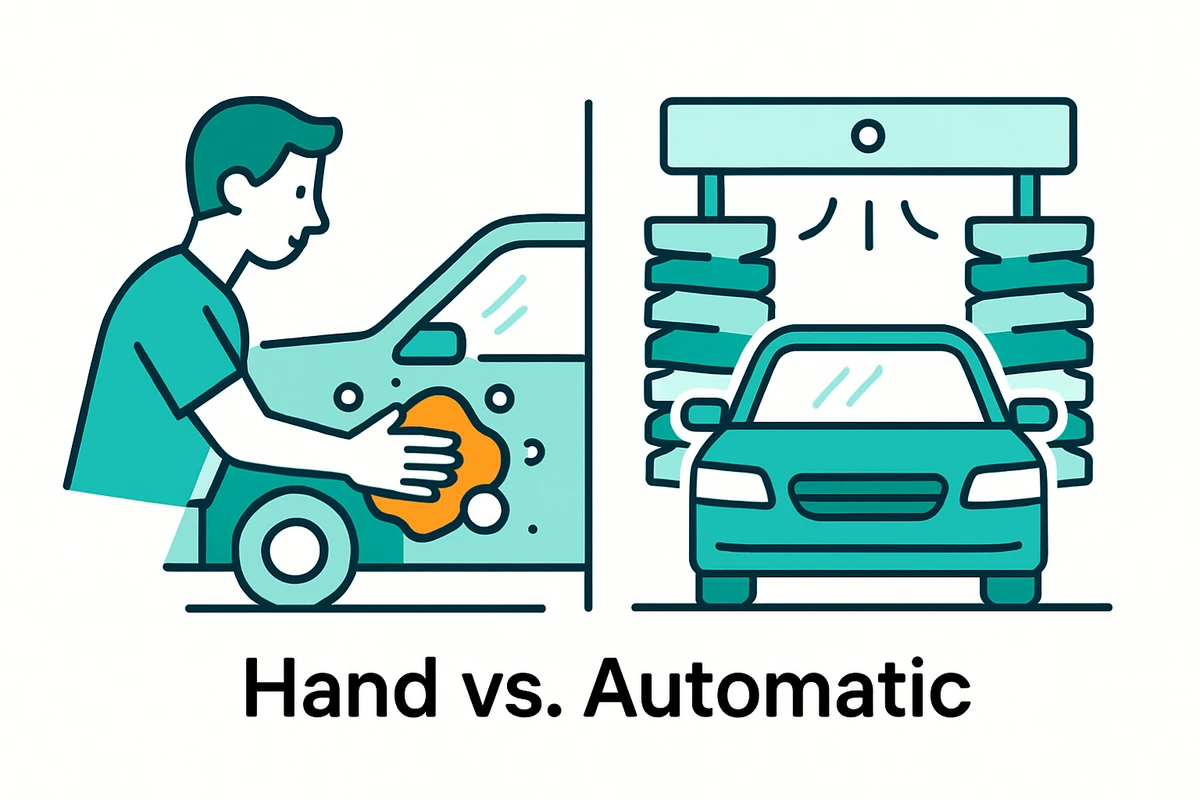
This is the single most common question people ask: is it better to hand wash your car or run it through a car wash? The honest answer is that both methods work, and the right one depends on your priorities.
Here's how the two stack up across the factors that matter most:
Automatic Car Wash
- Fast and efficient
- Consistent, repeatable results every time
- Wins on convenience
- Low damage risk when properly maintained
Hand Car Wash
- Full control over every panel
- Adapts to your car — not one-size-fits-all
- Better suited to deep cleaning heavily soiled vehicles
- Gentler on paintwork; brushless approach protects finish
That last point matters. Automatic washes have a reputation—partly deserved, partly outdated—for scratching paint. Modern systems use soft materials and carefully controlled processes.
When properly maintained, they're safe for most vehicles, even newer models with sensitive finishes. The flip side: a careless hand wash with a dirty sponge can do more damage than a well-maintained machine.
Professional hand washers, though, make a strong case. One large operator argues that hand washing provides more thorough cleaning and is gentler on paintwork, since automatic brushes can leave scratches or miss hard-to-reach areas that a person would catch (Star Car Wash).
Most careful owners land on this: a combination works best. Routine cleaning to stay on top of dirt, then a thorough hand wash when your car needs real attention.
Why a Careful Hand Wash Is Gentler on Your Paint
If hand washing has one headline advantage, it's paint safety—but only when it's done correctly. Understanding why explains a lot about how to wash a car well.
Your car's paint is protected by a thin, clear top layer. Fine scratches and hazy "swirl marks" that show under direct light are usually caused by dragging grit across that surface.
Every speck of road dust and sand is essentially tiny sandpaper, so the entire art of safe washing comes down to lifting dirt away from the paint rather than grinding it in.
A machine with fixed brushes can't tell the difference between a clean panel and a gritty one. A careful hand washer can.
That's why hand washing's gentleness hinges on technique: hand washing wins on paint safety precisely because the person can rinse grit away first, use clean tools, and adjust pressure by hand.
Some hand washes lean into this so heavily they refuse to use brushes at all; customers specifically credit their brushless approach with protecting their cars' finishes.
Tools matter as much as method. Never let ordinary sponges touch your paint—they scratch the finish. A soft microfiber towel or a car-specific wash mitt is far safer (Driveway).
Microfiber wash mitts are gentle while still lifting dirt effectively, and microfiber drying towels help prevent water spots (Panda Hub). None of this is expensive or complicated, but skip it and you'll quietly put swirl marks into your own paint.
How to Hand Wash a Car, Step by Step
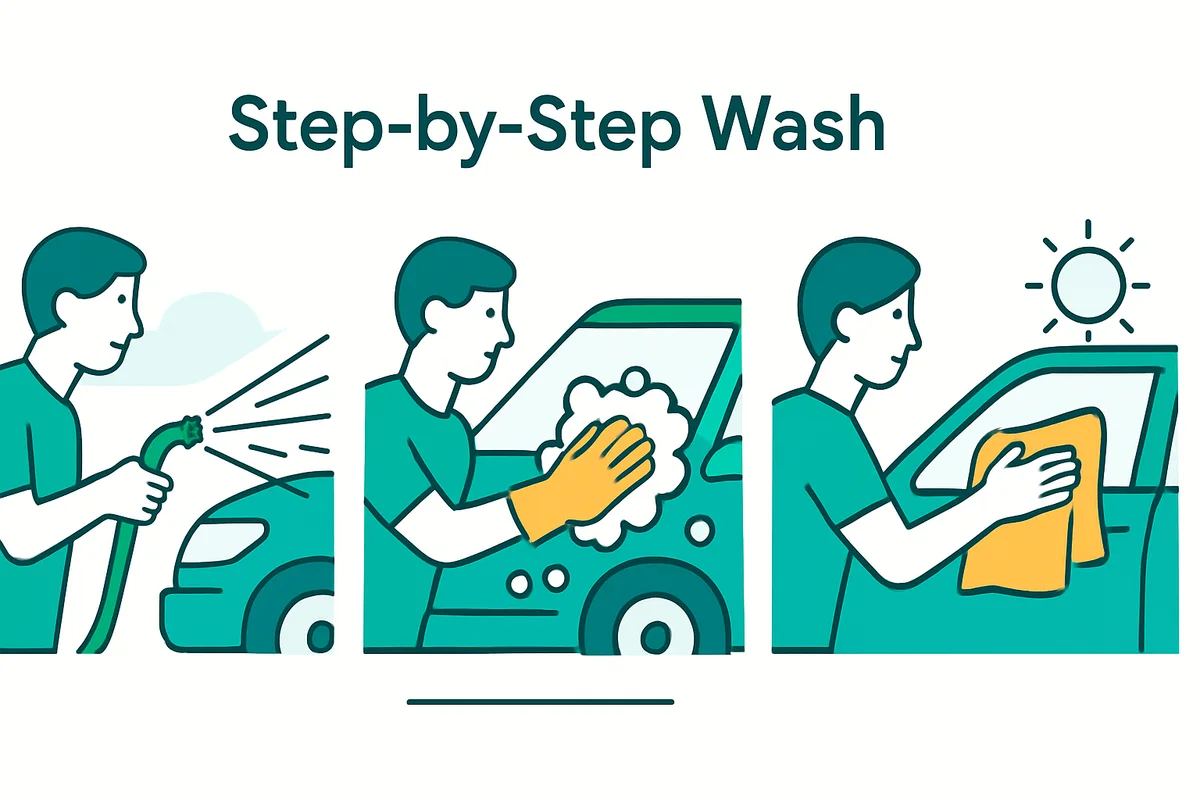
The most practical question is: how do you actually hand wash a car? Here's a reliable sequence that works whether you're cleaning a sedan or a large SUV.
-
1
Start in the shade
Find shaded spots if you can. Direct sunlight makes soap dry faster and water evaporate quickly, making the whole job harder and increasing spot risk. Washing away from direct sun keeps soap and water on the surface longer, reducing water spots before you can rinse.
-
2
Gather your supplies first
Grab car-specific soap, a soft wash mitt or microfiber towel, at least two buckets, a hose, and clean microfiber towels for drying. Having everything within reach means you won't walk away mid-wash and let soap dry on the paint.
-
3
Pre-rinse the whole car
Start by rinsing the car to remove loose dirt and debris, paying attention to wheel wells and undercarriage where grime builds up. This initial soak loosens bird droppings, dirt, and debris.
-
4
Do the wheels first
Tackle the dirtiest part of the car at the start, using a separate brush and ideally a separate bucket of soapy water for the wheels. Wheels accumulate the most dirt and brake dust; cleaning them first with dedicated tools prevents that heavy grime from transferring onto the rest of the car.
-
5
Wash the body from top to bottom
Dip your mitt in soapy water and clean from top to bottom—soapy water naturally drips downward as you work. Lower panels are always dirtiest, so saving them for last keeps that dirt away from cleaner areas.
-
6
Rinse and dry immediately
After washing a section, rinse it thoroughly to remove all soap, then dry right away with a clean microfiber towel or chamois. Prompt drying—especially around mirrors and door edges—is what prevents water spots.
-
7
Finish the glass, and consider protection
Clean the windshield and windows with ammonia-free glass cleaner, wiping until there are no streaks. Don't forget the wiper blades. Once the car is fully dry, apply quality wax if you want added protection and shine; spray wax is easiest to use. Waxing after a wash improves appearance and shields the paint from UV rays and other harsh elements.
Follow that order and you've covered the fundamentals that separate a safe, thorough wash from a hurried one.
The Two-Bucket Method and Other Scratch-Prevention Basics
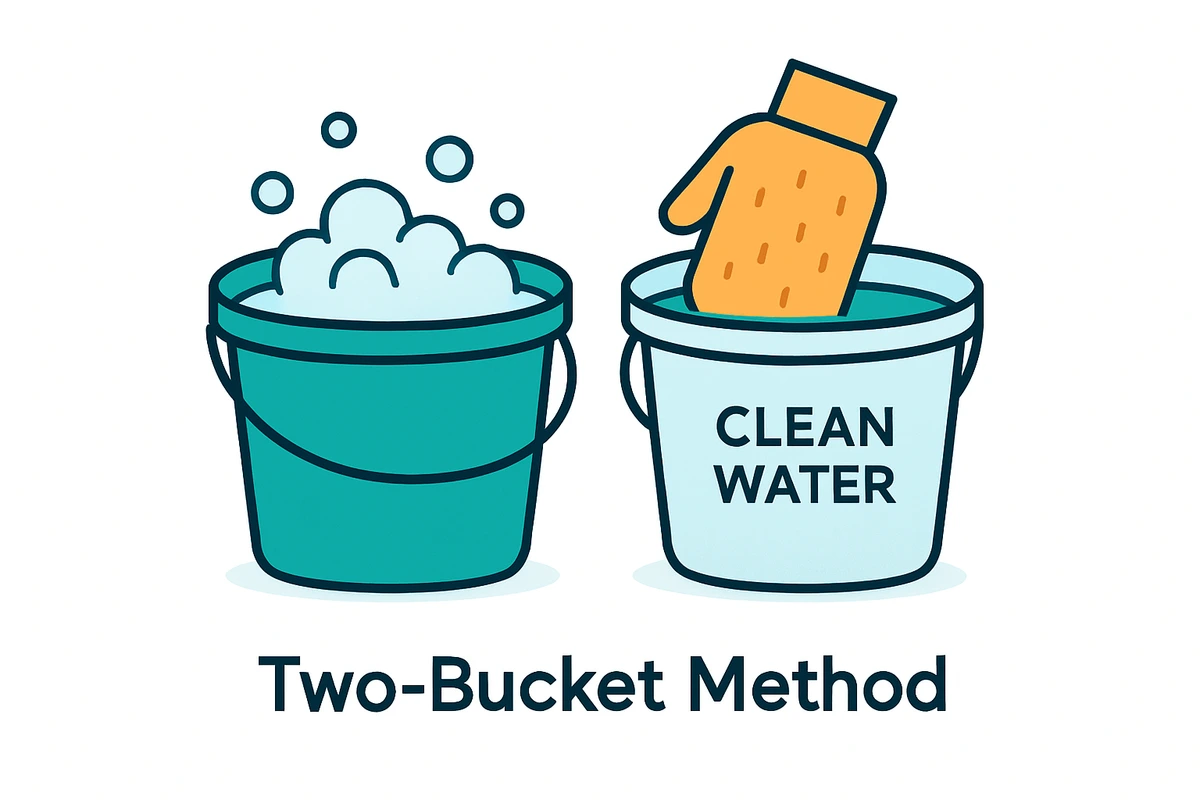
If there's one technique worth singling out, it's the two-bucket method, because it directly addresses hand washing's biggest risk: putting dirt you just removed straight back onto the paint.
Fill one bucket with clean, soapy water and a second with plain water for rinsing your mitt. Instead of dunking a dirty mitt back into your soap, rinse it in the plain-water bucket first, then reload with clean soap. This approach prevents dirt from being re-deposited as you work. Detailers warn against the single-bucket habit for the same reason: you don't want to keep dunking your mitt into the same water and putting grime right back onto the car. Add a third bucket just for the wheels, since you'll be dealing with far more dirt there.
Two more habits round out safe technique. First, use straight strokes rather than circular motions when you wash, and rinse the mitt frequently—both help avoid swirl marks.
Second, choose the right soap. Milder is better, and a car-specific formula is what you want. A pH-balanced, car-specific shampoo cleans without stripping protection.
Professional hand washes rely on pH-neutral shampoos precisely because they protect paintwork while they clean.
Common Hand-Washing Mistakes to Avoid
Hand washing depends heavily on technique, so the same handful of mistakes account for most accidental damage. Each one is easy to avoid once you know about it:
Mistakes that account for most accidental damage
- Using dirty sponges or towels. A grit-loaded sponge drags contaminants across the paint and scratches it. Keep your tools clean and rinse them often.
- Applying too much pressure. Scrubbing hard doesn't lift stubborn dirt any better—it just increases marring risk. Let the soap and a gentle motion do the work.
- Using household soaps. Standard household detergents strip wax and damage paint, which is why car-specific products are worth the small extra cost.
- Letting the car air-dry. Leaving water to evaporate on its own is one of the most common causes of spots. Dry promptly with microfiber instead.
The pattern behind all four is the same: shortcuts that feel harmless in the moment leave lasting marks. Avoid them and even a modest home wash can look genuinely professional.
Hand Wash vs. Full Detail: What's the Difference?
One of the most frequently searched questions is the difference between a wash and a full detail, and it's a fair source of confusion because the terms overlap and are used loosely.
Think of it as depth. A wash—hand or machine—is about cleaning the surfaces you can readily see and touch: rinsing dirt, washing paint, cleaning glass, and usually a basic interior vacuum.
A professional hand wash package typically covers exterior wash with quality shampoo, tire shine, wheel cleaning, exterior windows and mirrors, and interior vacuuming of mats, seats, and boot.
Detailing goes further. It's the intensive work of restoring and protecting a vehicle beyond ordinary cleaning, layering in treatments a routine wash skips.
Premium packages mean full hand wax polish, clay bar treatment to remove bonded surface contaminants, leather conditioning, and deeper interior work like carpet extraction.
Some hand washes offer detailing as a distinct upgrade combining their most complete wash with hand wax and other extras (Soap Hand Car Wash). Dedicated operations advertise hand carnauba waxing, interior and exterior detailing, and leather seat conditioning as services separate from a standard wash.
So the short version: a wash keeps your car clean. A detail restores and protects it. Hand washing is where a good detail begins, but detailing is the extra layer of correction and protection on top.
Is a Full Detail Worth It?
If a wash gets your car clean, why pay considerably more for a detail? Whether it's worth it comes down to what you're trying to achieve.
A detail makes sense when you want more than clean. Because detailing restores a vehicle toward showroom condition and adds lasting protection, it makes sense in a few specific situations.
If your paint's picked up bonded contamination that keeps it feeling rough even after a wash, clay bar treatment during a detail removes what washing can't. If you're preparing to sell, the value case is direct: regular, thorough cleaning protects your paint and clear coat, prevents corrosion, and maintains resale value.
And if your interior has accumulated stains, odors, or embedded grime, the deep interior treatments in a detail address problems a quick vacuum never will.
For a car you simply want looking tidy week to week, detailing at every visit is overkill; a good hand wash is plenty.
Most owners settle into a sensible pattern: frequent washes to stay on top of dirt, with a full detail once or twice a year or before a sale to reset condition and protection. Waxing after regular washes bridges the gap by adding protection and shine between details.
What Goes Into a Professional Hand Wash
If you decide to leave the work to professionals, it helps to know what you're actually buying. Reputable hand washes structure services in tiers, and understanding those tiers makes picking the right level easy.
A typical menu starts with a basic exterior hand wash and builds upward. Higher tiers add tire shine, interior and exterior window cleaning, full interior vacuum, and interior wipe-down, with a top detailing tier that folds in hand wax.
Common add-ons include deep wheel cleaning, bug and sap removal, and leather cleaning or conditioning. A well-run wash also pays attention to finishing touches—hand-drying the body and glass with super-absorbent microfiber towels to prevent streaks, and using biodegradable soap followed by thorough high-pressure rinse.
These comprehensive packages are genuinely comprehensive. A full-service professional wash covers high-pressure rinse and hand wash, tire shine and wheel cleaning, interior vacuuming of mats, seats, footwells, and boot, cleaning of glass, mirrors, dashboard, console, and door trims, removal of tar and bugs, and protective wax polish—with clay bar and other treatments reserved for premium detailing.
When comparing options, the checklist is simple: quality car-specific shampoo, proper microfiber drying, dedicated wheel cleaning, and clearly defined tiers so you're not paying for extras you don't need.
Is a Hand Car Wash Expensive? What Actually Drives the Cost
"Is hand car washing expensive?" is one of the most common questions, and the honest answer is that it depends far more on what you ask for than on the words "hand wash" themselves. Rather than quoting figures that vary by location, it's more useful to understand what drives price.
Several factors move the number up or down:
- The tier of service. This is the biggest lever. Published menus scale from a basic exterior hand wash at entry level up to full detailing packages that include hand wax and deep interior work. A quick exterior refresh and a full detail are simply different products at very different price points.
- Vehicle size and condition. A large SUV takes more time, product, and effort than a compact car. Hand washes commonly price larger vehicles higher and add charges for cleaning beyond normal use.
- Add-ons. Extras like deep wheel cleaning, bug and sap removal, headlight restoration, and leather conditioning are priced individually, so a "simple" wash can grow quickly.
- Time invested. Labor is the real cost. A professional express wash might take roughly 25 to 45 minutes, while a full detail runs 3 to 4 hours. More time means more cost.
Against that cost, consider the value of doing it right. Regular, careful washing protects your paint and clear coat, prevents rust and corrosion, and maintains resale value—meaning the money spent keeping a car clean often protects a much larger sum tied up in the vehicle itself.
Viewed that way, hand washing is less an expense than routine maintenance.
How Often Should You Wash Your Car?
Frequency matters more than method. Whichever way you clean your car, doing it regularly is what actually protects the vehicle, because dirt, salt, and environmental contaminants cause damage over time.
As a general guideline, washing every two to three weeks suits most drivers, but go more often if you drive frequently, park outdoors, or spend time in areas with dirt, salt, or pollution. For cars in harsh conditions, once a week or more is reasonable.
The right interval isn't a fixed rule—it's a response to how and where you drive. A garage-kept car driven twice a week needs far less frequent washing than one sitting outside collecting dust every day.
Water Use and the Environment
A fair question worth being honest about: which method is easier on water and the environment? The available claims point in different directions.
Professional hand washes argue their approach is more environmentally friendly, using less water along with biodegradable products—many use earth-friendly biodegradable soap as standard.
On the other hand, comparisons often note that hand washing frequently uses more water than an automated system, whose water use is controlled and optimized.
Both can be true, because it depends on who's doing the washing. A home wash where the hose runs continuously uses a lot of water, whereas a professional operation that reclaims water and uses controlled, efficient equipment can be quite frugal.
If you're washing at home, control the flow: rinse in stages rather than letting the hose run, and use a nozzle to manage water pressure and get a complete rinse without waste. Choose biodegradable, car-specific soap to keep what does run off as gentle as possible.
Hand Washing in Kuwait's Heat, Dust, and Hard Water
Most general car-washing guides are written for mild climates. Kuwait isn't mild, and a few local realities change how you should approach hand washing here. The advice below is practical for these conditions.
In a place where midday temps are punishing and the sun's intense much of the year, washing in the shade stops being optional. Direct sunlight makes soap dry faster and water evaporate quickly, making washing harder and inviting spots. Working out of the sun keeps soap and water on the surface longer, reducing water spots. The practical move: wash early morning or in a shaded area, work one section at a time, and rinse and dry each part before it flash-dries in the heat.
Respect the dust
Fine desert dust settles on paint constantly, and it's abrasive. This is exactly why the pre-rinse deserves extra care here: rinsing loose dirt and debris before any towel touches it minimizes scratching risk.
Never wipe a dusty car dry without rinsing first, and never skip the initial soak that floats grit away. In dusty conditions, the two-bucket method also earns its keep, since it keeps you from carrying abrasive grit back onto the paint.
Dry quickly to fight hard-water spots
Hard water leaves mineral deposits as it evaporates, and in the Gulf that means spots form fast on a hot panel. The defense is what detailers recommend everywhere, applied with more urgency: dry the car immediately with a clean microfiber towel or chamois, taking particular care with areas around mirrors and doors where water lingers.
A protective wax after the wash adds a layer that shields paint from the sun's UV rays—no small thing under a desert sky.
Wash a little more often, and mind the water
Because dust, heat, and outdoor parking are constants here, a Kuwait car generally benefits from washing more frequently, in line with advice to wash more often when you park outdoors or drive in dusty, polluted conditions.
At the same time, water is precious in this part of the world, so wash efficiently: control the flow with a nozzle, rinse in stages rather than letting the hose run, or use a professional service that manages water carefully.
Put together, these adjustments come down to one mindset: in a hot, dusty, hard-water environment, the margin for error is smaller, so the fundamentals of rinsing first, using clean tools, and drying fast matter even more.
Bringing It All Together
The bottom line
A hand car wash, at its best, is a careful, controlled way of cleaning a vehicle that protects the paint rather than risking it. Its advantage is control; its weakness is that same control puts the outcome in human hands, which is why technique matters so much: rinse grit away first, use clean microfiber and car-specific soap, wash top to bottom with the two-bucket method, and dry promptly. Do that and you get a finish that rivals professional work. Skip it and you'll quietly scratch your own car.
For everyday cleanliness, a good hand wash on a sensible schedule is all most cars need. For restoration and protection, that's where detailing, hand waxing, and deeper treatments come in.
In a climate like Kuwait's, where heat, dust, and hard water conspire against a clean finish, the smartest approach is often to let a professional handle it in the right conditions with the right tools and careful water use.
If washing a car by hand in the heat isn't how you want to spend your free time, that's exactly the gap a professional service fills. Wash & Polish offers a mobile car wash that brings a careful, by-hand exterior and interior clean to you anywhere in Kuwait, so your car gets the gentle, thorough treatment described in this guide without you lifting a bucket. However you choose to keep your car clean, the goal stays the same: a finish that looks its best and paint that stays protected for the long run.