In this guide
- Why Interior Cleaning Matters More Than It Looks
- The Supplies That Actually Make a Difference
- A Surface-by-Surface Method
- Can You Use Household Cleaners on Your Car? The Honest Answer
- Why Is My Car Interior Sticky? Diagnosing the Most Frustrating Problem
- Cleaning an Interior in a Hot, Dusty Climate
- Common Mistakes to Avoid
Your car's interior is the surface you touch more than almost any other in daily life. You wrap your hands around the steering wheel. Press buttons on the console. Drop your phone in the cupholder. Slide across the seat several times a day.
Yet somehow, the inside of a car is often the last thing that gets a proper clean. And when it finally does, it's usually cleaned with the wrong products in the wrong way.
This is why so many drivers end up with faded plastics, a strangely sticky dashboard, dry and cracking leather, or a cabin that smells worse a week after cleaning than it did before. The good news? A genuinely clean interior isn't complicated. It's about understanding a handful of surfaces, using products designed for them, and following a routine that matches how hard you actually use your car.
This guide covers the whole process: what supplies you actually need, how to work surface by surface, which household cleaners and wipes are safe (and which aren't), how often to clean, and how to fix the specific problems people search for most. Sticky interiors. Lingering odours. Faded trim.
It's written with Kuwait's reality in mind — heat, sun, and fine dust put extra stress on everything inside the cabin.
Why Interior Cleaning Matters More Than It Looks
It's tempting to treat interior cleaning as purely cosmetic. Something you do before selling the car. Or when guests are riding along. But that's not how it works. Keeping the cabin clean is maintenance, not just tidiness.
Detailing professionals note that regular cleaning prevents interior fabrics from breaking down and smelling bad, stops plastics from fading prematurely, and reduces wear over time (CARPRO). This helps the car stay in good condition longer.
Car and Driver agrees: freshening up the interior isn't just courtesy to passengers. Dirt, dust, and grime build up over time and degrade interior materials, leaving you with bigger problems than weird smells and ugly stains (Car and Driver).
The mechanism is straightforward. Dust and grit act like a mild abrasive — grinding into fabric and against plastic every time you move. Spills feed odours and attract more dirt. Skin oils transfer onto the steering wheel, gear shift, and seats.
Clorox describes it clearly: dirt comes from dust, pollen, debris carried through open windows and vents, or tracked in on shoes. Spilled drinks, food crumbs, skin oils — they all add up. Without regular cleaning and with moisture present, you get stains, odours, and stubborn buildup (Clorox).
None of this is dramatic on any single day. Accumulation does the damage. That's why a modest, consistent routine beats the occasional deep panic-clean.
The Supplies That Actually Make a Difference
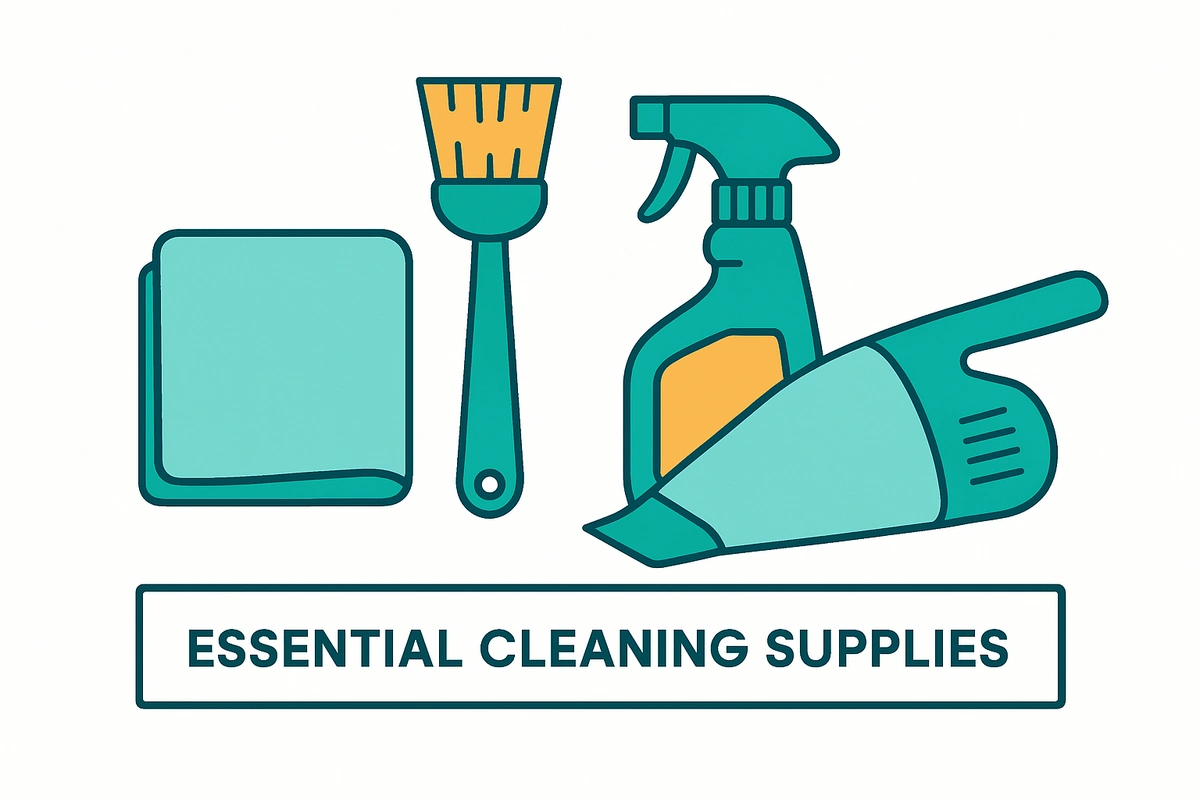
You don't need a professional detailing arsenal to clean an interior well. But the right basic tools save time and prevent damage. Soft tools and purpose-made cleaners protect surfaces. Harsh or improvised ones risk marking them.
Toyota's interior guide recommends a practical kit (Toyota): microfiber cloths (gentle, effective, won't scratch); all-purpose cleaner safe for leather, cloth, plastic, and vinyl; dedicated leather cleaner and conditioner; upholstery cleaner that won't leave residue; carpet cleaner; streak-free glass cleaner; vacuum with attachments; soft-bristle brush for agitating dirt; small detailing brushes for vents and crevices; plastic trim cleaner or restorer.
A few things deserve emphasis:
- Microfiber is the workhorse. Its softness is the whole point. It lifts dust instead of dragging it across a surface (which causes fine scratching on gloss and screens).
- A soft brush unlocks the details. Small brushes reach seams, vents, and button surrounds where a cloth can't go.
- A vacuum with attachments does most of the work. Most of what makes an interior feel dirty is loose dust and debris. That's a vacuuming problem, not a chemistry one.
Carpet cleaning deserves special attention. Toyota recommends using a foaming-type carpet cleaner applied with a sponge or brush in overlapping circles. And they caution: "do not use water" for that step.
In humid or slow-drying environments, soaking carpet traps moisture under the padding. That's one of the fastest ways to create the exact mould and odour problems you were trying to avoid.
A Surface-by-Surface Method
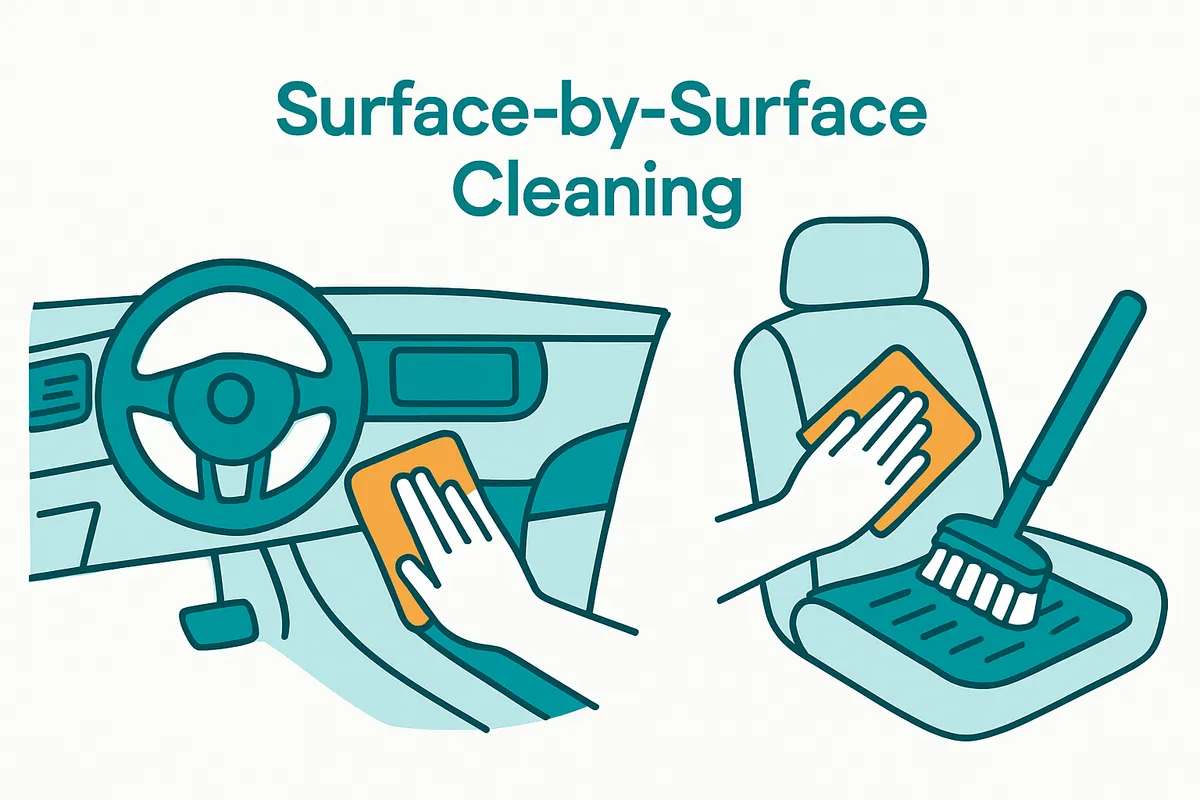
The single most useful mental shift in interior cleaning is to stop thinking of "the interior" as one thing. It's a collection of very different materials, each needing different treatment. Work top to bottom so dust you knock loose from high surfaces gets vacuumed up at the end rather than resettling on areas you already cleaned.
Start by Emptying and Vacuuming
Before any cleaner comes out, clear the cabin and vacuum thoroughly. Simple Green's detailing routine begins exactly here: empty the vehicle of trash and belongings, then vacuum to remove the loose debris that otherwise blocks your view, hides stains, and gets pushed around by liquid cleaners.
It recommends starting with the floor mats, working the built-up dirt loose before removing them, and vacuuming seats and crevices, collapsing or removing seats where heavy cleaning is needed (Simple Green). Clorox echoes the same sequence for soft surfaces: vacuum all carpeting and upholstery, including on door panels, collapse seats to reach crevices, and remove floor mats to vacuum underneath.
This step isn't glamorous, but it's where most of the visible improvement comes from. Skipping straight to spraying cleaner onto a dusty surface just turns dust into mud.
The Dashboard, Console, and Hard Plastics
The dash and centre console are high-touch, high-visibility, and made mostly of plastics and vinyl. The safe approach: a lightly dampened microfiber cloth with an appropriate all-purpose or interior cleaner, worked gently into the surface and around seams with a soft detailing brush.
For genuinely dirty hard surfaces, Simple Green notes that a diluted all-purpose cleaner works on washable surfaces without harsh chemicals, and that it's suitable for interior surfaces from plastic to metal fixtures. Clorox suggests using a small brush to scrub away gunky stains on hard surfaces where a cloth alone won't lift them.
One critical caution applies to anything electronic. When wiping the glovebox, air vents, sound system controls, and especially a touch screen, always follow the car manufacturer's own instructions for cleaning and disinfecting electronics. Infotainment screens often have delicate coatings, and the wrong solvent can permanently haze them.
The Steering Wheel, Gear Shift, and Touch Points
These are the germ-heavy zones. Your hands never leave them. Clorox recommends wiping all parts of the steering wheel including the turn indicator and gear shift, along with the cup holders on the centre console, and notes this is especially important in a car with multiple drivers.
The interior of each door deserves the same attention, including door handles, window controls, and locks.
Because these surfaces are most likely to get hit with disinfectant wipes, they're also most likely to be damaged by over-cleaning. We'll come back to that in the wipes section below.
Seats: Cloth, Leather, and Upholstery
Seats are where technique matters most. Wrong moisture levels are as damaging as wrong chemicals.
For fabric seats, Simple Green's method is to spray on a diluted all-purpose cleaner, focus on the dirtiest areas without putting too much liquid onto the seat, work deep into the cracks and crevices, agitate with a bristled brush, and then pull the loosened dirt back out with an extractor. The phrase "without putting too much liquid on the seats" is the key. Over-wetting fabric drives moisture into the foam beneath, where it lingers and breeds odour.
For leather, treat it as its own category. Toyota recommends a dedicated leather cleaner and conditioner and advises following the leather cleaner manufacturer's instructions. Clorox similarly notes that leather upholstery may require pre-cleaning with a leather cleaning product before anything else.
Leather needs conditioning after cleaning because cleaning removes oils, and unconditioned leather dries out and cracks. This risk is heightened in hot climates.
Glass, Last
Save the windows for the end so that overspray and dust from earlier steps don't undo your work. Clorox suggests using glass cleaner with a microfiber cloth and cleaning windows when the car is parked in the shade.
The shade tip is genuinely useful: on a hot glass surface, cleaner flashes off before you can wipe it, leaving streaks you were trying to avoid. Under a strong Kuwaiti sun, this is the difference between clear glass and a smeared mess. Clean windows early in the morning or in a shaded, covered spot.
Can You Use Household Cleaners on Your Car? The Honest Answer
This is where most search traffic lives. Everyone already owns Lysol wipes, Clorox wipes, and some kind of all-purpose spray. So the natural question is: can you just use those? The answer is nuanced, so let's take the common ones in turn.
Frequently asked questions
Can I Use an All-Purpose Cleaner on My Car Interior?
Generally yes, provided it's the right kind and properly diluted. Toyota's recommended supply list actually includes an all-purpose cleaner, ideally one that's safe for use on leather, cloth, plastic, and vinyl. So an all-purpose cleaner isn't off-limits in principle; the interior is full of surfaces an APC is designed to handle.
The important variables are strength and formulation. Simple Green, an all-purpose cleaner itself, advises diluting it with water at a ratio anywhere from 1:2 to 1:4 for cleaning the inside of a car — that's one part cleaner to two to four parts water — and reserving full-strength concentrate on a pre-wetted surface only for the heaviest jobs.
It stresses that your choice of cleaner is critical, because it needs to penetrate buildup without harming the various plastics, rubber, metals, fabrics, and fibres in the vehicle. And it highlights that a cleaner free of caustic or corrosive chemicals won't corrode automotive materials.
Read together, the practical rule is: an all-purpose cleaner is fine if it's free of harsh, caustic, or corrosive chemicals, if it's diluted appropriately rather than used at full strength, and if you test it on an inconspicuous spot first. A harsh, undiluted household degreaser is a very different thing from a diluted, gentle APC. Even though both wear the "all-purpose" label.
Can I Use Lysol or Clorox Wipes on My Car Interior?
This is the most-searched question in this whole topic, and the answer deserves care. The honest version is "occasionally and selectively, not as your routine cleaner."
Disinfecting wipes do have a legitimate place. Clorox's own guidance uses disinfecting wipes to wipe down hard, nonporous surfaces such as the glovebox, air vents, controls, steering wheel, gear shift, cup holders, door handles, window controls, and locks. To actually disinfect those hard surfaces, you should use enough wipes to keep them visibly wet for four minutes before allowing them to air dry. So on hard plastics and other nonporous touch points, used correctly, disinfecting wipes are a reasonable tool.
The problem is using them everywhere and using them often. A detailing shop that deals with the aftermath puts it plainly: many disinfectant wipes contain chemicals that are too harsh for automotive interior materials. While they can be used occasionally and sparingly on hard touch points like steering wheels, door handles, hard plastic buttons, and frequently touched surfaces, frequent use can cause fading and discoloration, dry and brittle leather, sticky or shiny residue, and breakdown of protective coatings (RetroClean Detailing). The underlying reason is chemistry: alcohol and strong cleaners strip oils and UV protection from interior materials.
That last point is especially relevant for anyone driving under intense sun. Interior plastics and vinyl rely on their factory finish and any protectant to resist UV. If routine wipe use is stripping away that protection, you're effectively accelerating the sun-fade and cracking that hot-climate interiors are already prone to.
The sensible approach is the one the same detailer recommends: limited use on hard touch points is okay. But routine cleaning should use interior-safe products. And even after using a wipe on a touch point, follow up with a gentle interior-safe cleaner or protectant to prevent drying.
To summarise the wipe question:
- Clorox or Lysol wipes on hard, nonporous touch points, occasionally: acceptable. To disinfect, keep the surface wet for the time on the label (four minutes for the disinfecting wipes referenced above).
- Wipes on leather, fabric seats, or as your everyday cleaner: avoid, because of fading, drying, and residue over time.
- Screens and electronics: defer to the manufacturer's instructions rather than any generic wipe.
Can You Spray Lysol Inside a Car?
Reputable guidance does not endorse spraying an aerosol household disinfectant freely around a car cabin, and the same principles that apply to wipes apply here even more strongly. The scraped sources don't specifically test aerosol Lysol on car interiors, so treat what follows as practical advice rather than a sourced product claim.
The concerns are twofold. First, the harsh-chemical issue is identical to the wipe problem: the alcohols and strong solvents that make a disinfectant effective are the same ones that strip oils and protective coatings from interior materials over time. A broadcast spray coats fabric, leather, plastics, and screens indiscriminately, including the very surfaces that harsh chemicals damage most.
Second, ventilation. Even purpose-made automotive disinfecting products are meant to be used with airflow: Clorox advises that when spraying its disinfecting mist, the interior should be well ventilated with windows down or a door open.
If your goal is disinfection rather than cleaning, the safer route is targeted, not atmospheric: wipe hard touch points with an appropriate product and keep it wet for the labelled contact time. If you sanitise soft surfaces, use a product intended for that purpose applied correctly, as covered next. Fogging the whole cabin with a general-purpose room aerosol? That's not something the reputable guides recommend.
What About Disinfecting Fabric Seats and Carpet?
Soft surfaces need a different method than hard ones. Clorox's approach is to hold a disinfecting mist six to eight inches from the surface and spray evenly until the upholstery or carpet is wet but not saturated. Keep soft surfaces visibly wet for one minute to sanitise before allowing them to air dry. Always with the cabin well ventilated.
The recurring instruction across every soft-surface step is to wet, not soak. Saturation is what leads to trapped moisture and odour.
Is Dawn Dish Soap Safe on a Car Interior?
This is another frequently searched question that the reputable sources here don't directly answer. So the responsible reply is a considered "with caution," offered as advice rather than a sourced fact.
Dish soap is a degreaser designed to cut oils, which is precisely why it's risky on interiors: on leather it can strip the very oils that keep the material supple. On protected or coated surfaces it can dull the finish over time. That's the same "strips oils and protection" failure mode that harsh cleaners exhibit.
Given that dedicated interior and all-purpose cleaners are inexpensive and formulated not to harm the mix of plastics, rubber, fabrics, and fibres inside a car, there's little reason to reach for dish soap as a routine interior cleaner. If you ever do, keep it heavily diluted, keep it off leather entirely, and test it somewhere hidden first.
Why Is My Car Interior Sticky? Diagnosing the Most Frustrating Problem
A sticky dashboard. Tacky door pulls. A gummy centre console. These are some of the most common and most annoying interior complaints. Usually they have an identifiable cause rather than being random.
One cause is directly documented: sticky or shiny residue is a known consequence of frequent disinfectant-wipe use on interior surfaces. If your dash turned tacky after you started wiping it down regularly with household disinfecting wipes, you've likely found your culprit. The residue is a combination of the wipe's own additives and the breakdown of the surface's protective coating.
Beyond that, the likely causes are best understood as advice rather than sourced claims, drawn from how interiors behave:
- Product buildup. Over-application of a "shine" dressing, or repeatedly cleaning without ever removing the previous product, leaves a film that stays tacky, especially in heat.
- Sugary spills. A spilled soft drink or juice that dried into the plastic grain or fabric will feel sticky long after it looks clean. It needs to be broken down and lifted out, not just wiped over.
- Heat and degrading plastics. Sustained high cabin temperatures can cause certain soft-touch plastic coatings to break down and become gummy on their own. Anyone parking in direct sun through a hot summer will recognise this. It's one more reason to keep interiors properly cleaned and, where appropriate, protected rather than stripped.
The fix in almost every case is the same: stop adding to the problem, then remove what's there. Clean the affected surface with a diluted, gentle all-purpose cleaner that penetrates buildup without harming the plastic. Agitate stubborn spots with a soft brush. Stop using harsh wipes on that surface so residue doesn't return.
For genuinely degraded soft-touch coatings, cleaning will remove the tack but the coating itself may be permanently altered. That's why prevention through gentle products beats aggressive cleaning.
How Often Should You Clean Your Car's Interior?
There's no single universal number. The honest answer depends on how you use the car. But the reputable sources converge on a workable framework: a light routine clean often, and a full detail a few times a year.
For the deep clean, detailing professionals broadly agree that a complete interior detailing should happen at a bare minimum of two to three times a year, roughly once every four to six months. The exact frequency depends on how much wear and tear you put the vehicle through. If you keep things reasonably tidy between cleans, the lower end of that range is fine. If your daily life involves a lot of dirt on your clothes, food in the cabin, or other heavy use, you should detail more frequently.
For the lighter maintenance clean, Clorox recommends aiming for a monthly basic cleaning, such as vacuuming and wiping down surfaces to keep dirt, dust, and crumbs under control. High-touch areas like the steering wheel, gear shift, and door handle should be disinfected more often, especially during cold and flu season.
Then adjust upward for your reality. Frequent food in the car, kids, pets, sand and fine dust, or a job that puts grime on your clothes all push you toward the more-frequent end. Exactly as the professionals advise.
Cleaning an Interior in a Hot, Dusty Climate
Everything above applies anywhere, but a few realities of driving in Kuwait are worth calling out. These are practical adjustments rather than new facts. They're reasoned recommendations based on the surface behaviours the sources describe, not localised claims.
Fine dust is relentless, so lean on vacuuming. In a dusty environment, particulate is the dominant reason an interior feels dirty, and it accumulates fast through open windows and vents. Frequent, thorough vacuuming with a brush attachment for vents and seams does more to keep the cabin feeling clean than any spray. It removes the abrasive grit before it can grind into fabric and plastic.
Protect against UV rather than stripping it. Interior materials rely on their finish and any protectant to resist sun damage, and harsh cleaners strip that protection. Under strong, sustained sun, that makes the case for gentle, interior-safe products and appropriate conditioners even stronger than it is in a mild climate. Every routine wipe with a harsh product is undoing protection the surface badly needs.
Mind the heat when you clean. Cleaner and glass product flash off far faster on a scorching surface. That's why the shade-and-cool advice matters more here.
Clorox's tip to clean windows when the car is parked in the shade is a small thing that makes a large difference on a hot day. Cleaning early in the morning or under cover, before the cabin bakes, gives products time to work instead of drying into streaks.
Condition leather, and do it consistently. Cleaning leather removes oils. Dedicated leather care exists precisely to restore them. That's why the reputable guides pair leather cleaner with conditioner. Hot, dry conditions accelerate the drying and cracking that conditioning is meant to prevent. Treat conditioning as part of the job, not an optional extra.
Common Mistakes to Avoid
Pulling the threads together, a handful of mistakes account for most interior damage and disappointment:
Common mistakes
- Spraying cleaner onto a dusty surface. Vacuum and clear debris first, or you just make mud.
- Using harsh wipes as your everyday cleaner. Occasional use on hard touch points is fine, but routine use invites fading, drying, and sticky residue.
- Over-wetting seats and carpet. Wet, don't soak; saturation traps moisture and breeds odour. Some steps like foaming carpet cleaner are explicitly meant to be done without adding water.
- Using full-strength cleaner where diluted would do. Dilute an all-purpose cleaner appropriately and save concentrate for the heaviest, pre-wetted jobs.
- Ignoring the manufacturer on electronics. Screens and controls have their own rules; follow them.
- Cleaning leather without conditioning it. Cleaning strips oils; conditioning puts them back and prevents cracking.
- Skipping the shade. Cleaning glass and surfaces in direct heat leaves streaks and wastes product.
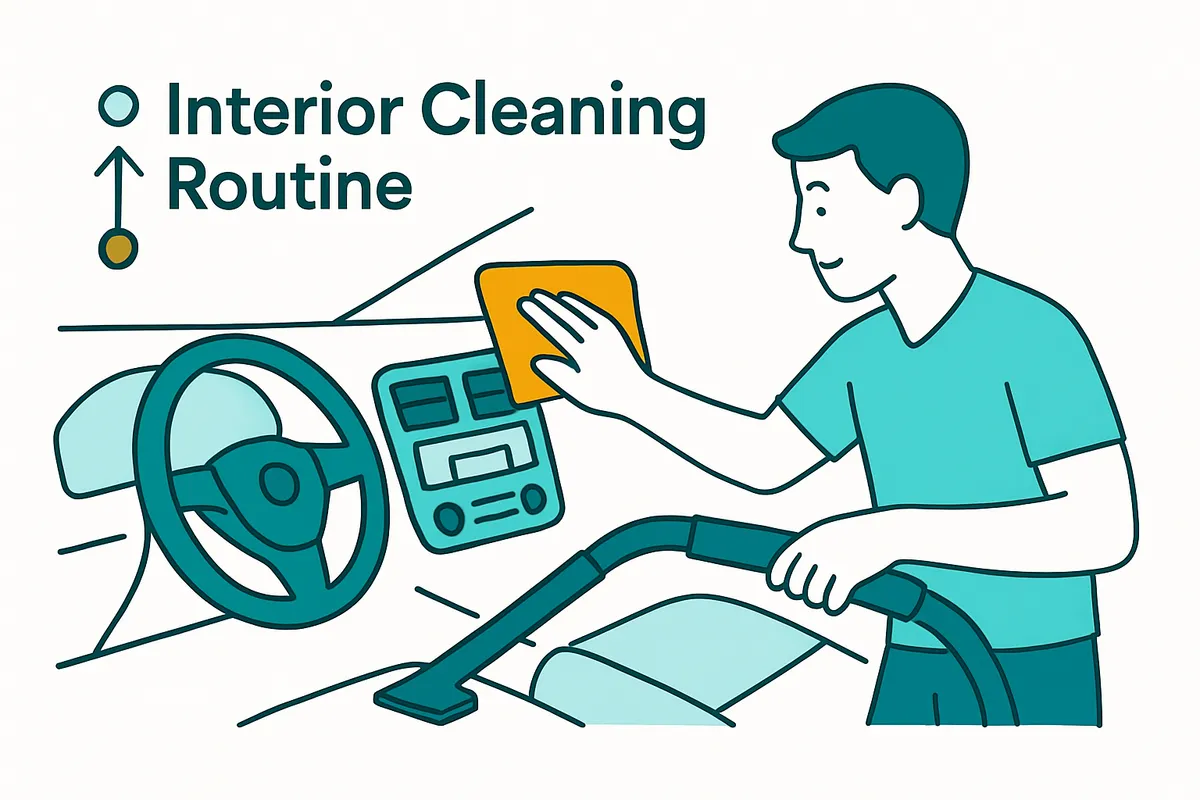
If you want one repeatable sequence, this pulls the sourced methods into order:
A Simple Interior Cleaning Routine You Can Actually Keep
-
1
Clear it out
Remove trash and belongings so nothing hides dirt or gets in the way.
-
2
Vacuum everything
Floor mats first, then seats, carpets, and door panels, collapsing or removing seats and lifting mats to reach crevices;.
-
3
Wipe hard surfaces top to bottom
Dashboard, console, steering wheel, gear shift, door interiors, and touch points, using a microfiber cloth with an appropriate cleaner and a soft brush for stubborn spots. Defer to the manufacturer on electronics;.
-
4
Treat the seats by material
Diluted all-purpose cleaner agitated and extracted on fabric without over-wetting; dedicated cleaner and conditioner on leather;.
-
5
Handle carpet correctly
Use a foaming carpet cleaner applied with a sponge or brush in overlapping circles rather than soaking it.
-
6
Finish with glass, in the shade
Glass cleaner and a microfiber cloth, with the car parked out of direct sun.
-
7
Let everything air dry, ventilated
Allow treated surfaces to air dry fully before driving, with windows down or a door open.
Do the quick version weekly, the full version monthly, and a proper deep detail every four to six months. Adjust for how hard you use the car;.
The bottom line
A clean interior is not about buying the most products or scrubbing the hardest. It's about matching the method to the material: vacuum before you spray, use gentle interior-safe cleaners rather than harsh household ones, dilute what needs diluting, wet rather than soak, condition your leather, and reserve disinfecting wipes for occasional use on hard touch points instead of making them your everyday tool.
Do that on a sensible schedule, and you avoid nearly every problem people search for. Sticky dashboard. Faded plastics. Lingering smells. You'll be genuinely protecting the value and comfort of your car.
If your interior has drifted past the point where a weekend routine can recover it, or you simply want the deep, material-by-material treatment done properly, that's exactly the kind of work the Interior Deep Cleaning service at Wash & Polish is built for. We restore seats, carpet, dashboard, and stubborn stains with methods and products chosen to suit each surface.